
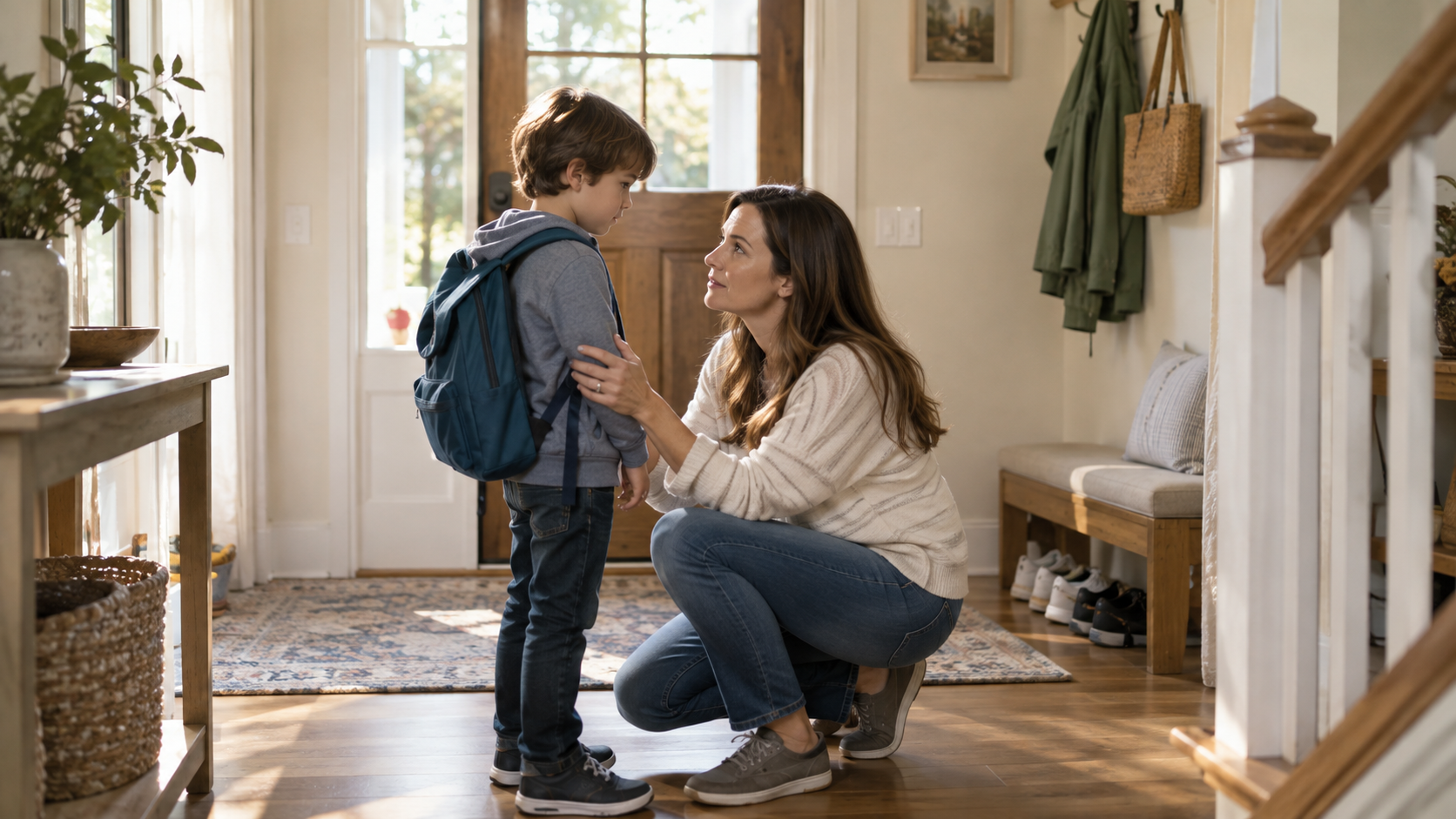
School Morning Anxiety: What to Do When Your Child Says “I Can’t Go”
Articles
Sep 13, 2026
Back-to-school anxiety is common in kids of every age. Learn the signs, why it happens, and practical ways NY parents can help their child cope this school year.

If your child seems more clingy, irritable, or "off" than usual as September gets closer, they're far from alone — and so are you. Anxiety disorders affect roughly a third of young people at some point during adolescence, and school is consistently one of kids' biggest everyday worries, with many thinking about it at least once a week. For most families, back-to-school anxiety is a normal, temporary response to a big transition. The good news: there's a lot parents can do to make it smaller and shorter, starting well before the first bell rings.
Anxiety doesn't always look like worry on the surface. Depending on your child's age, you might notice:
Younger children tend to show anxiety through their bodies and behavior. Teens are more likely to talk around it, get short-tempered, or pull away socially rather than name a specific fear.
A few things are usually at play: separation from a parent or a familiar routine, uncertainty about a new teacher, classroom, or social group, academic pressure (real or imagined), and simply the disruption of trading a loose summer schedule for early alarms and structured days. None of that means something is wrong with your child — it means their nervous system is responding normally to genuine unknowns.
Start the routine early. Shift bedtimes and wake-ups back toward the school schedule about one to two weeks before the first day, rather than all at once. A well-rested kid handles uncertainty far better than an exhausted one.
Do a practice run. If you can, drive or walk the route to school, or visit the building before the first day. Familiarity, even a small amount, takes the edge off the unknown.
Validate instead of dismissing — or over-promising. "You don't need to worry about that" can accidentally tell a child their feelings aren't valid. "It makes sense to feel nervous about something new — let's think through it together" does more to actually calm them down.
Give them some control. Let your child pick out supplies, choose their first-day outfit, or pack their own backpack. Small decisions build a real sense of readiness.
Teach one simple coping tool. A few slow breaths, naming five things they can see, or a specific phrase they say to themselves — something concrete they can use in the moment, not just in theory.
Keep goodbyes short and confident. Kids read parental anxiety instantly. A quick, warm, unhurried goodbye communicates far more safety than a long, anxious one.
Most back-to-school anxiety eases within the first couple of weeks as routines settle in. It's worth reaching out to a professional if your child's anxiety isn't improving after the first few weeks, if it leads to regularly missing school, if physical symptoms are frequent and severe, or if you notice panic attacks. If your child ever expresses hopelessness or thoughts of not wanting to be here, treat that as urgent — reach out to their pediatrician, a mental health professional, or the 988 Suicide & Crisis Lifeline right away.
Elite Therapeutic Services, based in Stony Brook, offers licensed child therapy and adolescent counseling to families across New York, using evidence-based approaches like CBT and mindfulness to help kids build real tools for managing anxiety — not just get through one hard morning. Sessions are available by telehealth, so there's no added commute on top of an already busy school-year schedule, and we accept a wide range of insurance plans, including Fidelis, Aetna, Cigna, and UnitedHealthcare, among others. If this school year is starting with more worry than you'd like to see, reach out — we're here to help your child, and you, feel ready.